Theory & reading · Any instrument
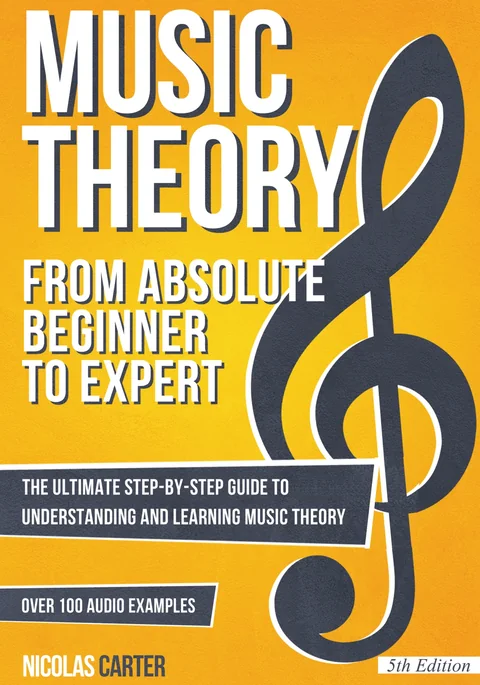
Music TheoryFrom Absolute Beginner to Expert
Understand how notes, intervals, scales, chords and rhythm fit together.
- Print length
- 406 pages
- Print size
- 7 × 10 in
- Language
- English
Make it part of your music stand.
Your local Amazon store opens when you choose a format. Prices and availability are shown there.
What you’ll work on
- Sound, pitch and the twelve notes
- Reading music on the staff
- Intervals, by sight and by ear
- Scales, modes and keys
- Chords, progressions and voice leading
- Rhythm, meter and groove
Is this the book for me?
For beginners and intermediate players who want to understand the music they play. You don't need to read music to begin.
Alongside your book
Pair the ideas on the page with the free audio examples.
PracticeFull book description
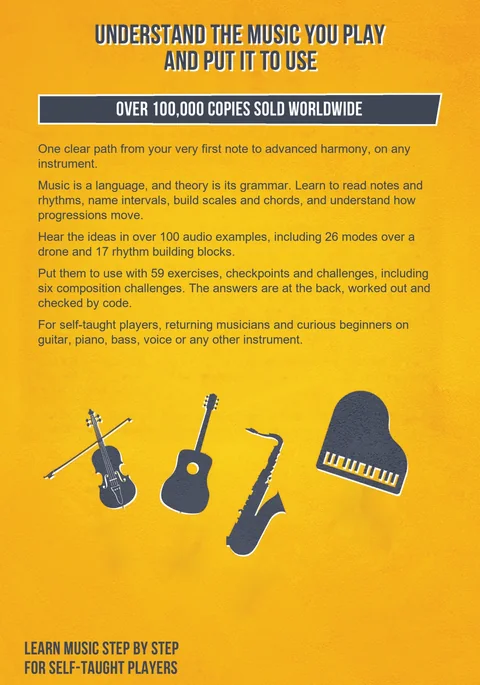
Understand the music you play and put it to use – one clear path through music theory, from your first note to chords, progressions and rhythm, on any instrument.
Most of us come to theory wanting the same thing. We want to know why a song works, find our way around the instrument, play by ear, improvise, and maybe write our own music. This book takes you there one step at a time, in six parts. It starts with what a note is and why we have 12 of them, and it ends with your first short compositions, built from what you have learned.
Music isn't math. Music is a language, and theory is its grammar. Every idea here is explained in plain words, shown on the keyboard and the staff, and tied back to how it sounds.
What's inside
- Part 1, Fundamentals: sound and pitch, the twelve notes, octaves and registers, middle C and tuning, why we have 12 notes, and note names around the world.
- Part 2, Music Notation: the staff, clefs, accidentals and key signatures, repeats, dynamics and articulation, and a Notation Workout that ends with an eight-bar melody to read and play.
- Part 3, Intervals: naming every interval, compound and inverted intervals, telling them apart by sight and by ear, consonance and dissonance, and the overtone series.
- Part 4, Scales and Modes: the major scale in every key, minor and relative keys, the circle of fifths, pentatonic and blues scales, the modes of the major, harmonic minor and melodic minor scales, and the whole-tone, diminished and bebop scales.
- Part 5, Chords: triads and suspended chords, seventh chords, the chords of a key, inversions, voicings and voice leading, progressions, arpeggios, and extended, added and altered chords.
- Part 6, Rhythm: dividing the beat, simple, compound and odd time, triplets, swing and polyrhythms, syncopation and groove, and 17 rhythm building blocks you can hear.
- Going Beyond the Foundations: why the same note does a different job in every context, what “expert” really means, and six composition challenges that use the whole book.
- Under the Hood: the math behind the book, for the curious: the ratios of the intervals worked out step by step, and how twelve equal steps divide the octave.
Hear it as you read. 124 numbered audio examples go with the text, and the modes are played over a drone, so you can hear the character of each one. In the paperback and hardcover, every example has a QR code beside it; scan it, or type the short address, and the clip plays. Every example is listed below, part by part.
Check yourself. Parts 1, 3, 4, 5 and 6 end with a Checkpoint, and Part 2 with the Notation Workout. The answers are at the back of the book, and every note, chord and rhythm answer has been computed and checked by code.
Who it's for. Self-taught players who want to know what they're doing, musicians coming back to music after years away, and curious beginners – on guitar, piano, bass, voice or anything else. Theory works the same on every instrument.
Before you start. You don't need to read music to begin: Part 2 teaches it from zero. If you're starting from scratch, take Part 1 slowly; the boxes marked For the curious go deeper and can wait for a second read.
First published in 2016. Nicolas Carter's music theory books have sold more than 100,000 copies, and this fifth edition grew out of ten years of readers' questions.
Room to work it out
Free printable worksheets for every exercise, Checkpoint and Challenge in the 5th edition. The answers are in the book.
Get the printable worksheetsEvery example, part by part
- 1
Music Theory Fundamentals
9 examples - 2
Music Notation: The Written Language of Music
12 examples - 3
Intervals: How Notes Relate, and How to Hear Them
13 examples - 4
Scales and Modes: Where Melodies Come From
38 examples - 5
Chords: How They Are Built and Why They Work
19 examples - 6
Rhythm: Beat, Time and Groove
33 examples
Music Theory: From Absolute Beginner to Expert · 5th edition · Example 1.3
One note.
Four different sounds.
C4 (261.6 Hz) on a flute, a piano, a violin and a voice, then all four together, a short rest between
- Flute
- Piano
- Violin
- Voice
A closer look
The covers, up close.